5 Signs Your Hot Water System Needs Replacing (Not Just Repairing)
Learn when to repair and when to replace your hot water system. Warning signs that indicate it's time for a new unit.
Every hot water system eventually reaches the point where no amount of tinkering can save it.
You know that feeling of dread when the shower suddenly runs cold on a winter morning.
It’s the moment most homeowners realize they might have ignored the warning signs for too long.
From our experience with hot water repairs across Perth since 2021, we see a clear pattern: people wait until catastrophic failure to act.
Delaying the decision often leads to emergency call-out fees and rushed choices on expensive appliances.
Knowing the specific indicators of a dying system allows you to budget for a replacement on your own terms.
Here are the five definitive signs that a repair job just won’t cut it anymore.
Sign 1: The Unit Has Surpassed Its “Statistical” Lifespan
Age is the single most reliable predictor of failure.
While we all hope our appliances last forever, the reality is that Australian harsh water conditions and constant thermal expansion take a toll.
If your system was installed before 2012, you are essentially on borrowed time.
Typical Lifespan by System Type
We use this breakdown to help Perth locals benchmark their current system:
| System Type | Average Lifespan (AU) | Warning Zone |
|---|---|---|
| Electric Storage (Vitreous Enamel) | 8-12 years | 10+ years |
| Gas Storage (3-4 Star) | 10-15 years | 12+ years |
| Gas Instantaneous (Continuous Flow) | 15-20 years | 15+ years |
| Heat Pump | 10-15 years | 10+ years |
| Solar (Tank & Panels) | 15-20 years | 15+ years |
Replacement becomes the smarter financial move once you hit that “Warning Zone.”
The “Domino Effect” of Old Units
Repairing a system past its prime is often a waste of money.
Components inside older units tend to fail in quick succession.
You might spend $300 replacing a thermostat today, only to have the heating element blow next month, or the tank rupture the month after.
Spare parts for models older than 15 years, especially from brands that have changed manufacturing standards like older Rheem or defunct Dux models, can also be difficult or impossible to source.
Our professional rule of thumb: If the repair quote is more than 50% of the cost of a new unit, and the system is over 10 years old, put that money toward a new installation instead.
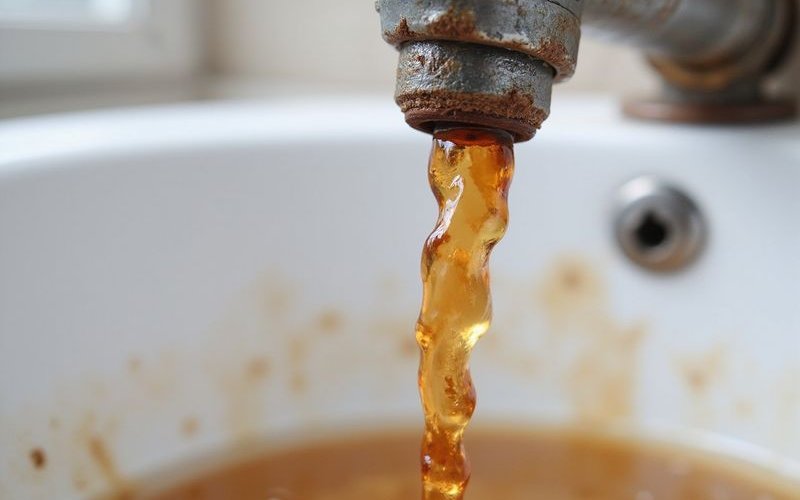
Sign 2: Rusty or Brown Water (The Tank Killer)
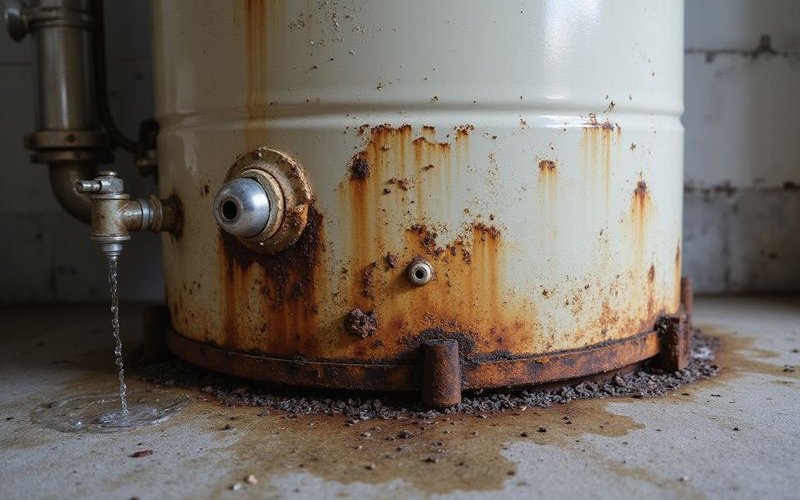
Clear water from the cold tap but brown water from the hot tap is a distinct diagnostic signal.
This discoloration almost always indicates that the internal cylinder is rusting from the inside out.
The Role of the Sacrificial Anode
Most storage tank systems in Australia use a glass (vitreous enamel) lining to protect the steel tank.
To back this up, manufacturers install a “sacrificial anode rod” designed to attract corrosion so the tank doesn’t.
Once that anode is fully depleted—usually after 5 to 7 years if not replaced—the corrosive elements in the water attack the steel tank directly.
Why You Can’t Fix This
Internal rust is terminal for a hot water system.
You cannot re-line a residential water tank once the enamel has been compromised.
Rust weakens the structural integrity of the cylinder, turning it into a ticking time bomb for a major leak that could flood your home.
The Bucket Test
If you are unsure, try this simple test:
- Fill a white bucket with hot water from the laundry tub.
- Let it sit for 5 minutes.
- Check for reddish-brown sediment at the bottom.
Visible sediment confirms the tank lining is stripping away, and replacement is your only safe option.
Sign 3: Pooling Water Around the Base
Finding a puddle at the foot of your hot water unit is the most urgent sign on this list.
While some moisture is normal, knowing the difference between a safety discharge and a structural leak is critical.
Scenario A: Relief Valve Discharge (Fixable)
All Australian hot water systems are fitted with a Pressure Temperature Relief (PTR) valve.
This valve is designed to vent small amounts of water to release excess pressure during the heating cycle.
If the valve is dripping continuously or releasing a steady stream, it may just need replacing—a relatively inexpensive job.
Scenario B: Tank Failure (Replace Immediately)
Water seeping from the seam of the tank, the top rim, or directly from the bottom (not a pipe) indicates a ruptured cylinder.
This is what we call a “catastrophic seam failure.”
Moisture here means the steel has expanded and cracked.
How to Distinguish the Leak
Take a close look at the source of the water.
- Coming from a pipe/valve: Likely a repairable plumbing washer or valve issue.
- Coming from the metal casing: The tank has split.
A split tank will never heal; the leak will only accelerate, potentially causing hundreds of dollars in water damage to flooring or cabinetry.
Sign 4: Banging, Popping, or “Kettling” Noises
Your hot water system should generally be felt and not heard.
When a tank starts sounding like a boiling kettle or a bag of rocks, it is suffering from severe sediment accumulation.
The Science of the Sound
Perth and many parts of WA have varying degrees of water hardness.
Over time, minerals like calcium carbonate settle at the bottom of the tank (in gas units) or encrust the heating element (in electric units).
The “banging” sound is actually steam bubbles trapped under the sediment layer trying to escape.
Why This Signals the End
Thick layers of scale do three things to your system:
- Overheating: The steel bottom of the tank overheats because the water can’t cool it down, leading to cracks.
- Element Death: In electric systems, the element expands and splits the copper sheath when encased in rock-hard scale.
- Capacity Drop: The sediment physically takes up space, giving you less hot water.
Flushing the tank is a maintenance task that works on new systems, but on an old unit, the sediment has likely calcified into concrete.
Removing it at that stage often causes leaks, meaning a full replacement is the safer path.
Sign 5: Unexplained Spikes in Energy Bills
Water heating accounts for roughly 25% of the average Australian household energy bill.
If your usage habits haven’t changed but your quarterly electricity or gas bill has jumped significantly, your hot water unit is the likely culprit.
The Efficiency Drop
As systems age, they have to work much harder to heat the same amount of water.
Insulation inside the tank casing degrades over time, causing “standby heat loss,” where the water cools down rapidly, forcing the unit to reheat it constantly even when you aren’t home.
Scale buildup on heating elements also acts as an insulator, meaning the element has to stay on longer to heat the water through the mineral crust.
The Financial Argument for Upgrade
Holding onto an old electric storage unit is often a false economy.
Modern systems are drastically more efficient.
Swapping a standard electric hot water system for a modern heat pump or solar setup can reduce your water heating costs by up to 70-80%.
Government incentives, such as the Small-scale Technology Certificates (STCs), often significantly reduce the upfront cost of these energy-efficient replacements.
We frequently see customers save $600 to $900 annually on power bills simply by upgrading to a heat pump, paying off the new unit in under three years.
When to Repair vs. Replace: The Decision Matrix
Making the final call can be tough.
Use this checklist to clarify your position.
Lean Toward Repair When:
- Age: The system is under 8 years old.
- The Issue: It is a single replaceable part (e.g., thermostat, element, PTR valve).
- Condition: The tank exterior looks clean with no rust.
- Cost: The quote is under $400 AUD.
Lean Toward Replacement When:
- Age: The system is 12+ years old.
- The Issue: The tank is leaking water or producing brown water.
- Performance: You run out of hot water constantly (capacity issues).
- Economics: You want to access government rebates for energy efficiency.
The Assessment Approach
You shouldn’t have to guess when it comes to a major home appliance.
We pride ourselves on offering honest assessments that look at the long-term picture for your home.
Our team evaluates the age, condition, and repair history of your unit before making a recommendation.
We will never push you to replace a unit that just needs a simple valve swap, but we will also be direct if a repair is just throwing money away.
Contact us for a free assessment of your hot water system.
Hot Water System Perth Team
Local hot water experts serving Perth since 2021. Licensed plumbers specialising in heat pump and solar hot water systems.